Created Art of the Byzantine Byzantine Art Is Usually
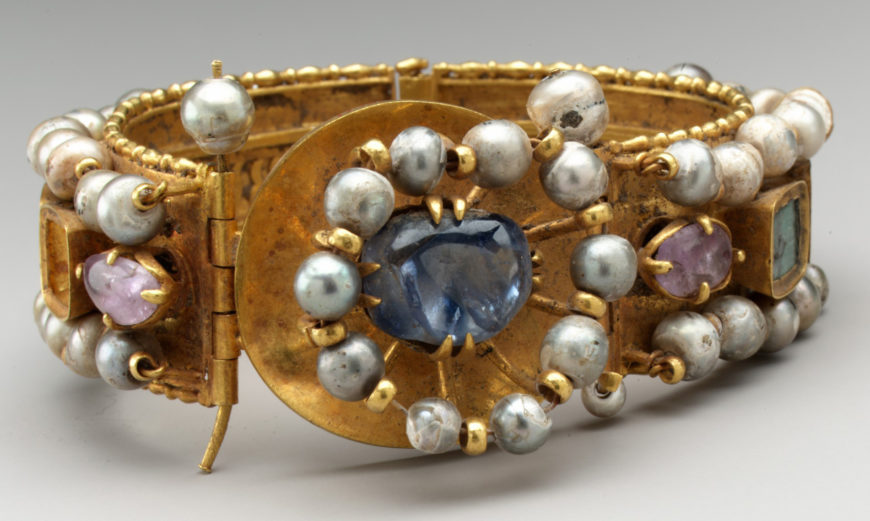
Bracelet, early on Byzantine, 500–700, Constantinople (?), aureate, silver, pearl, amethyst, sapphire, opal, glass, quartz, and emerald plasma, c. 4 x 8 cm (The Metropolitan Museum of Art)
Today, works of Byzantine fine art are typically encountered in museum settings, divorced from their original contexts of use. For this reason, it is often easy to forget that these objects once participated actively in Byzantine life. This is especially true of things worn on the body. Earrings, bracelets, belts, necklaces, and garments were meant to be seen in move, changing their appearance as they refracted calorie-free, as they were concealed and revealed on the torso, and as their wearers—both women and men—engaged in every day and ritual practices. The role of wear and jewelry was not simply commonsensical: habiliment art in Byzantium communicated complex messages about social identity, religious behavior, and concerns virtually physical and spiritual well-being.
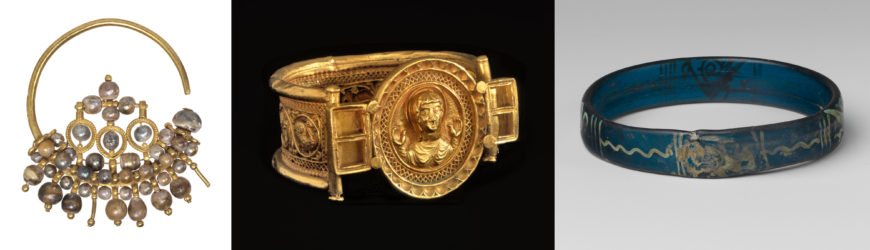
Left to right: Crescent Earring, 10th century, aureate with pearls, 7.2 x v.7 cm (© Dumbarton Oaks); Bracelet, c. 600, gold, four.3 x 6.9 x six.4 cm (photo: The British Museum, CC BY-NC-SA 4.0); Bracelet with Birds and Geometric Patterns, 1100–1400, drinking glass with argent stain, diam. 7.5 x 1.iv 10 0.4 cm (The Metropolitan Museum of Fine art)
Byzantine bling: Materials, techniques, and aesthetics of adornment
Bracelet, early Byzantine, 500–700, Constantinople (?), gold, silver, pearl, amethyst, sapphire, opal, glass, quartz, and emerald plasma, c. 4 x viii cm (The Metropolitan Museum of Art)
The Byzantines inherited a well-developed tradition of physical adornment from ancient societies, including technologies for cultivating plants and animals that yielded fibers for weaving textiles; sourcing and working natural materials like metals, pearls, and gems; and technology the production of synthetic materials like glass and
Pearls were harvested from the body of water and were typically small in size. They were often strung and practical as framing elements on clothing and jewelry. Precious gems—such as sapphires, amethysts, and emeralds—were imported from throughout medieval Afro-Eurasia and were prized for their color and shape. The Byzantines did not exercise faceting. Instead, gems were smoothed and polished to enhance their color and luminosity.
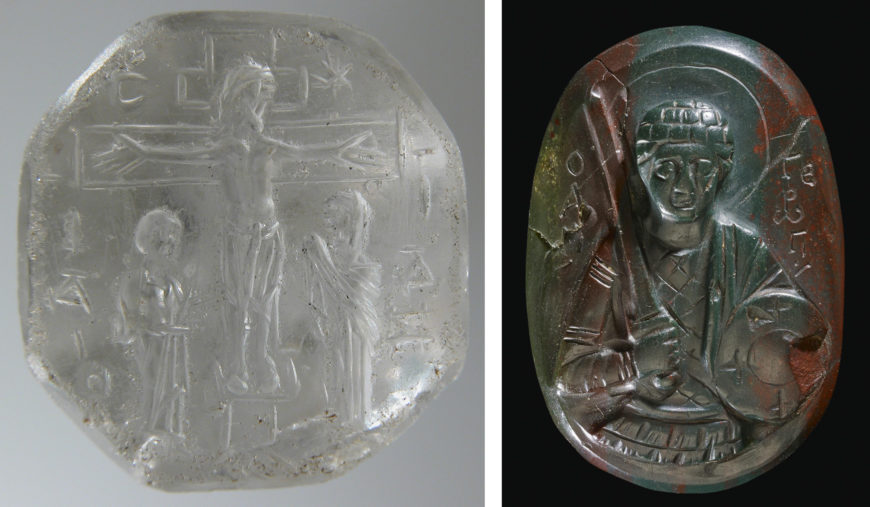
Left: Engraved intaglio Seal with the Crucifixion, 9th–11th century, rock crystal, 2 ten ane.8 x two.4 cm (The Metropolitan Museum of Fine art); right: Carved Cameo with Saint George, 11th–twelfth century, bloodstone, 4.one x ii.viii 10 1 (photograph: The British Museum, CC BY-NC-SA 4.0)
Gems and semi-precious stones were also engraved and carved in relief, as seen with this engraved intaglio seal with the Crucifixion and this carved cameo with Saint George. Natural gems of comparable size and shape were peculiarly prized.
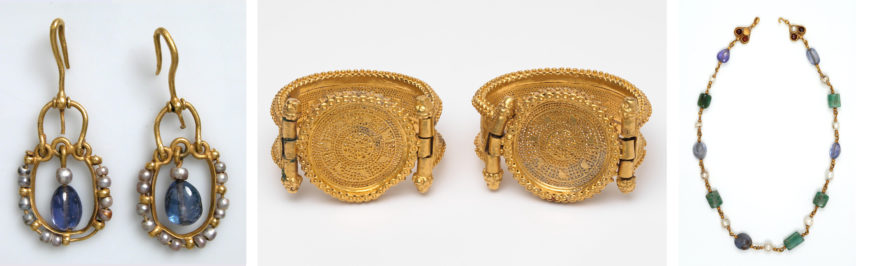
Left to right: Golden Earrings with Pearls and Sapphires, 6th–7th century, 6.1 ten ii.four ten 1.ii cm (The Metropolitan Museum of Fine art); Pair of Bracelets, c. 400, gold, c. 7 10 half-dozen ten 4.v cm (The Metropolitan Museum of Art); Necklace with Pearls, Emerald Plasma, and Sapphires, early fifth century, gold and gems, 37 cm (© Dumbarton Oaks)
Earrings or bracelets of matching pattern or necklaces with regular, repeating elements imposed symmetry on the wearer's trunk. The Byzantines historic well-proportioned and balanced physical features, and objects of beautification that enhanced these qualities were especially desirable. [1]
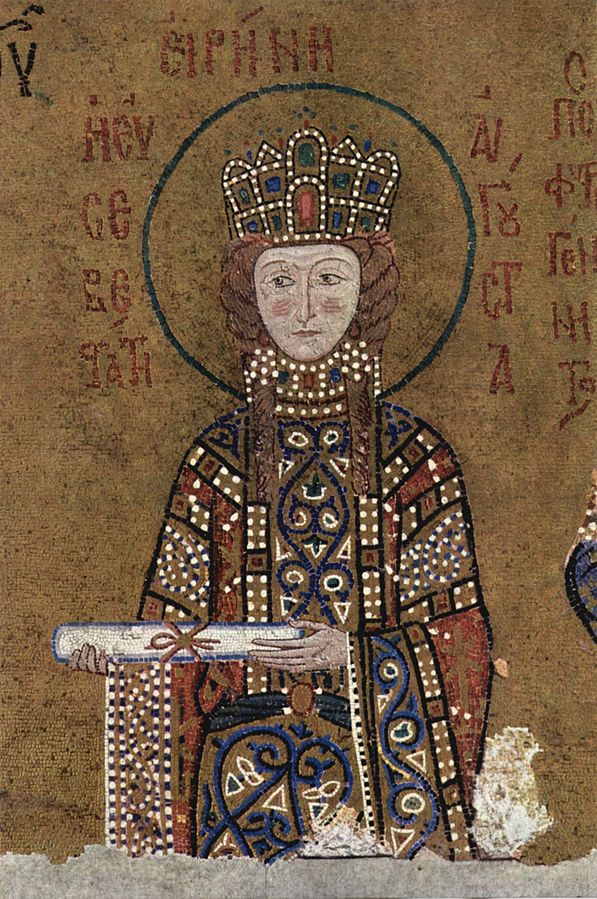
This portrait of the eleventh-century empress Eirene projects Byzantine ideals of symmetry and proportion in physical advent. She is depicted with a circular face, bifurcated by an aquiline olfactory organ and delicately counterbalanced by bow-shaped lips. Her arched brows, almond-shaped eyes, rosy cheeks, and finely braided pilus are arranged evenly on each side. Her gem encrusted crown and collar, pearl earrings, and elaborately adorned garment enhance the impression of beautiful residuum. Portrait of Empress Irene, heart Byzantine, 1118, mosaic, Church building of Hagia Sophia, Constantinople (Istanbul) (photograph: Wikimedia Eatables, CC0)

Marriage Belt, Byzantine, late sixth–early 7th century, gold, four.8 x 75.v cm (photo: byzantologist, CC By-NC-SA ii.0)
More refined examples of Byzantine jewelry ofttimes incorporated gold and silver, which were manipulated in complex ways such that these objects conveyed their value in terms of both materials and craftsmanship. This fragile pair of tenth- or eleventh-century golden basket earrings, for case, concentrate in their pocket-size forms several demanding techniques of metalworking, including granulation and grid (wirework). Through their mastery of these and other techniques, Byzantine artisans created earrings, rings, necklaces, belts, and bracelets of astounding fineness and intricacy.
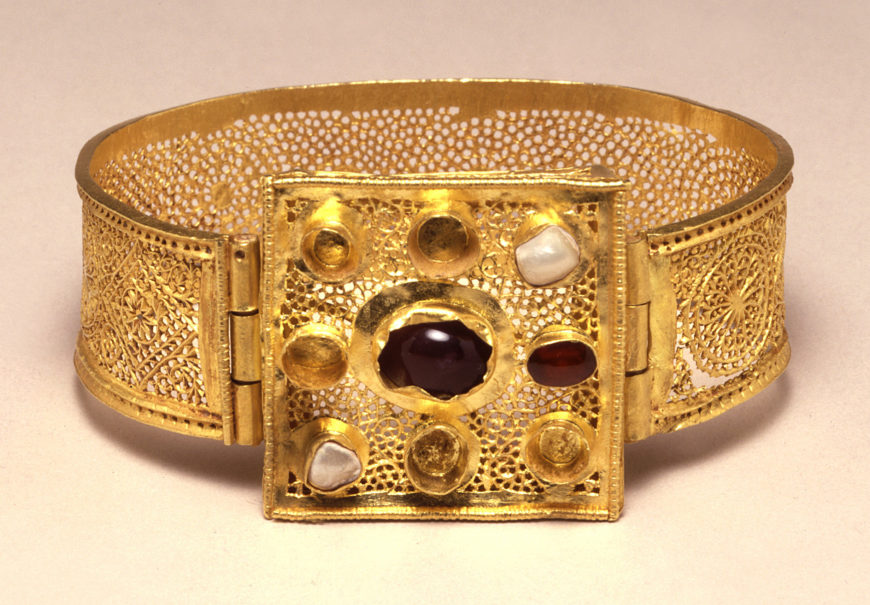
Example of opus interrasile, Bracelet with Jeweled Clasp, quaternary century, gilt and gems, 3.five x vii.4 cm (©Dumbarton Oaks)
Metallic jewelry was also cast and subsequently busy by ways of engraving, repoussé, chasing, and punching. Byzantine metalworkers were especially skilled in the refined grade of punching known as opus interrasile ("work [shaped] between"), which involved delicately piercing metal sheets to create fine patterns. Niello was used to highlight patterns and inscriptions, every bit in this Early on Byzantine bracelet (above) engraved with the possessor'smonogram and this centre Byzantine ring (below) engraved effectually the band with rinceaux and on the bezel with the possessor'south name and courtroom championship along with a brief evocation for divine assistance, "Lord assist Leontius, Patrician and Count of royal Opsikion guarded by God."
The Byzantines also made jewelry in less precious materials, including ceramic, glass, and base metals like bronze and copper.
Some of these downwardly-market items of personal adornment imitate objects in finer materials, for example, belt buckles and fibulae made of gilt-copper or gilt-statuary were burnished to appear like aureate.
The combination of natural and human-made materials is also constitute in these less luxurious items of adornment; early on Byzantine necklaces from Egypt pair amber or coral and glass.
Getting dressed in Byzantium: Garment types and ornament
The primary item of clothing in the early Byzantine era was the tunic, a sheath-like garment of elementary design. Men, women, and children of all social classes wore tunics, which were initially produced in untailored form that could be adapted to shape on the body with belts, pins, and tucks. Wool and flax (linen) were common materials for wear of all social classes, while garments of the elite could be produced in imported materials like cotton wool and silk. Individuals at all levels of gild embellished their wearable with decorations. More elaborate garments depict recognizable iconographic motifs, for example, an early Byzantine tunic from Egypt (below) busy with vignettes of Dionysus, the heathen god of vino, and his followers. Although Byzantine social club was increasingly Christianized by the fifth to sixth century when this tunic was created, Greco-Roman literature continued to exist a mainstay of the Byzantine educational system until the fifteenth century, and pagan mythology was well-known, peculiarly among the cultured elite. Images of Dionysus were especially pop in vesture and domestic textiles, perchance because he was associated with the pleasures of drinking, dancing, and merry making.
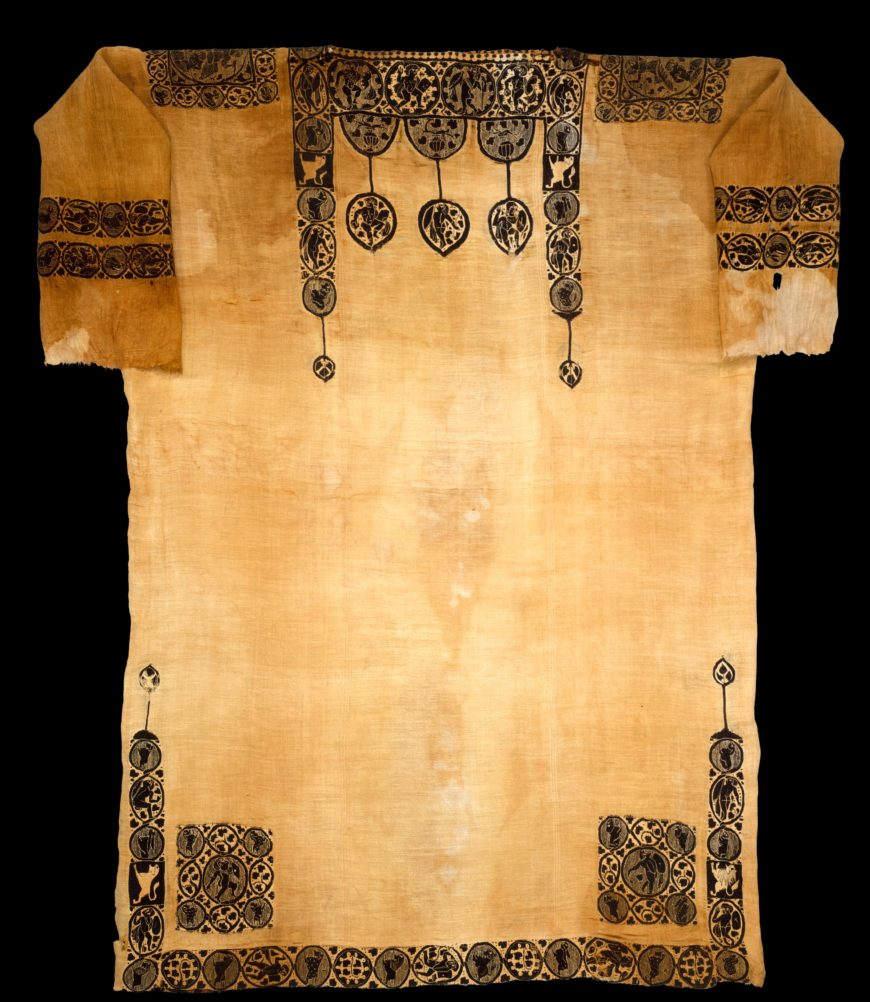
Tunic with Dionysian Ornament, probably fifth century, said to be from Panopolis (Akhmim, Arab republic of egypt), linen and wool, c. 183 x 135 cm (The Metropolitan Museum of Art)
Finished garments from other cultures were also imported to Byzantium. In the early on Byzantine period, Sasanian-style fitted garments were highly valued luxury objects considering they were usually fabricated from precious silken fabrics and ornamented with intricate, cute designs. They may accept also been appreciated for their tailored cut and the form-fitting silhouette information technology produced. Their fitted forms distinguished them conspicuously from the insufficiently shapeless tunics of Roman-Byzantine mode. The emulation of strange styles was not always condoned by Byzantine authorities. In the 6th century, the court historian Procopius criticized young men of the capital for dressing and arranging their pilus in "Persian" (i.east., Sasanian) and "Hunnic fashion." [two]
Byzantine clothing is best preserved in the burials of tardily antiquarian Egypt, where the dry climate and relatively express caste of modern urbanization accept left large numbers of belatedly antique funerary sites and their grave goods intact. Finds from these sites show that by the fifth century, clothing of even moderately wealthy individuals adopted elaborate decorations. In-woven designs were typically rendered in wool, which took dye more easily than flax (linen). Symmetry of the body was enhanced by tunic decorations that defined the shoulders, the vertical stretch of the breast, and the length of the arms.
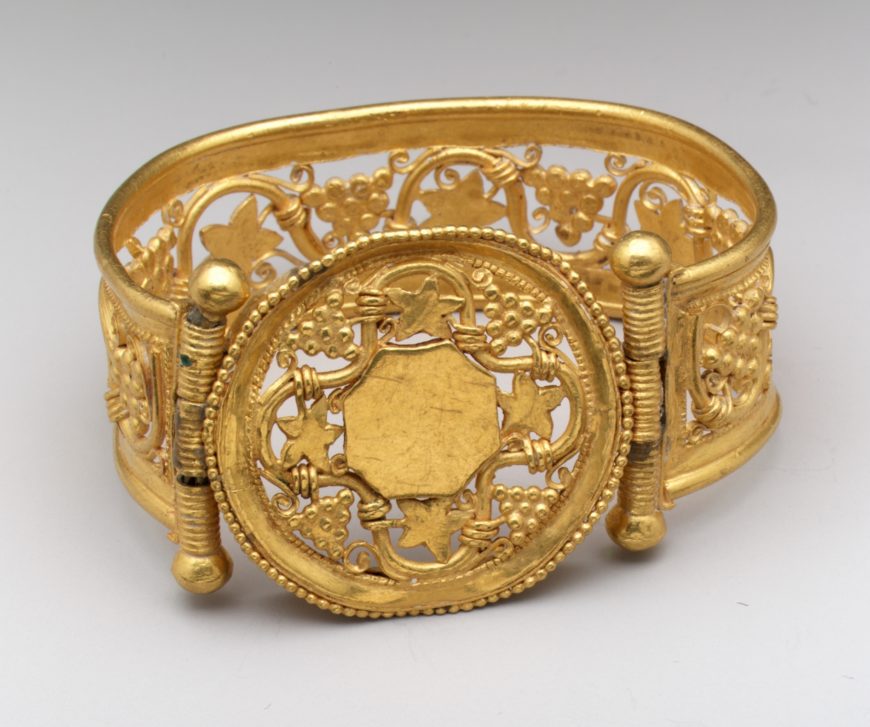
Bracelet with Grapevine Pattern, early Byzantine, mayhap Constantinople, late 6th–early 7th century, gilt, c. vi.v 10 3.5 ten 6 cm, 72g (The Metropolitan Museum of Fine art)
In the early Byzantine era, wearable and jewelry were decorated with a wide range of motifs. Some were primarily ornamental, such as geometric or vegetal designs. In the early centuries of Christianity, before the organized religion achieved widespread social and political endorsement, devotees risked persecution. Motifs that were polysemous (communicated multiple meanings) allowed the earliest Christians to avoid overt expression of their religious affiliation: only the initiated would recognize the Christian identity that these motifs conveyed. Many of these motifs continued in popularity even subsequently Christianity became the near exclusive religion of the Byzantine Empire. For instance, the grapevines on a sixth- or seventh-century gold bracelet (above) could be general signs of natural affluence and the practiced life, even an evocation of the pagan god of vino, Dionysus, or they could be understood as Christian signs that evoked Christ's sacrifice through reference to the Eucharistic wine that was mystically transubstantiated into his blood during the Christian liturgy. Similarly, the doves in a fifth-century opus interrasile bracelet (below) could recall the uncomplicated pleasures of nature, or they could operate every bit symbols for the Holy Spirit (one of the 3 elements of the Christian Trinity—God the Father, God the Son [Christ], and God the Holy Spirit).
Distinctly Christian iconography became prominent by the 5th century. Crosses and images of holy people served both to identify the wearer as Christian and to facilitate prayer and protection.
Up until the period of Iconoclasm (c. 726–843), jewelry and wearable regularly featured iconography from the heathen Greco-Roman tradition, such every bit images of deities like Aphrodite or Dionysus and his followers (as seen on the tunic discussed above).

Necklace with Pendant of Aphrodite Anadyomene, early on 7th century, golden and lapis lazuli, 43.2 10 twenty.iii ten one.9 cm (photo: © Dumbarton Oaks)
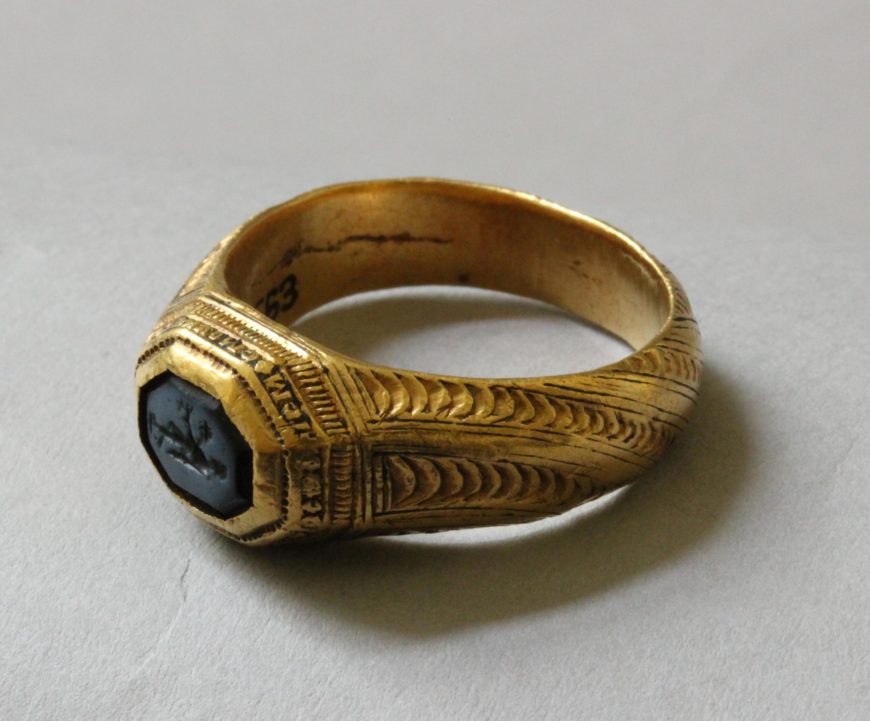
Classical iconography was found on ancient gems that were reused in Byzantine works of art, similar this fourteenth-century ring made in Constantinople and fix with a Roman-era engraved nicolo stone depicting the personification Bonus Eventus ("Good Outcome"), simply engraved with a protective phrase from the bible.
 The British Museum, CC BY-NC-SA 4.0)" width="724" height="600" srcset="https://smarthistory.org/wp-content/uploads/2021/07/1523907001-870x721.jpg 870w, https://smarthistory.org/wp-content/uploads/2021/07/1523907001-300x249.jpg 300w, https://smarthistory.org/wp-content/uploads/2021/07/1523907001-1536x1272.jpg 1536w, https://smarthistory.org/wp-content/uploads/2021/07/1523907001-2048x1697.jpg 2048w" sizes="(max-width: 724px) 100vw, 724px">
Signet-ring with an intaglio depicting Bonus Eventus, inscribed with a cross and an extract from Psalm 27.one in Greek: "The Lord is my lite and my conservancy; whom shall I fearfulness?" Late Byzantine, 14th century, Constantinople (Istanbul), gold and nicolo, diam. 2.8 cm (photo: The British Museum, CC BY-NC-SA 4.0)
Even after heathen cult practices were largely repressed and the majority of the Byzantine population had converted to Christianity, Greco-Roman iconography persisted every bit an keepsake of paideia , serving to affiliate the owner or wearer of an object with the classical learning and cultural refinement that medieval Byzantines continued to associate with Greco-Roman antiquity. After Iconoclasm, equally Christianity fully dominated Byzantine gild and heathen mythological iconography was no longer mutual in objects worn on the torso, protective motifs that originated in antiquity still endured, bearing witness to the survival of pre-Christian traditions. For example, the so-called Evil Center (which protected the wearer from the envy of others), the Holy Rider (who was thought to be powerful against demons and other evil forces) and the Chnoubis (a magical motif that was believed to be especially effective confronting headaches and ailments of the uterus) can exist found in medieval—and even modernistic—amulets.
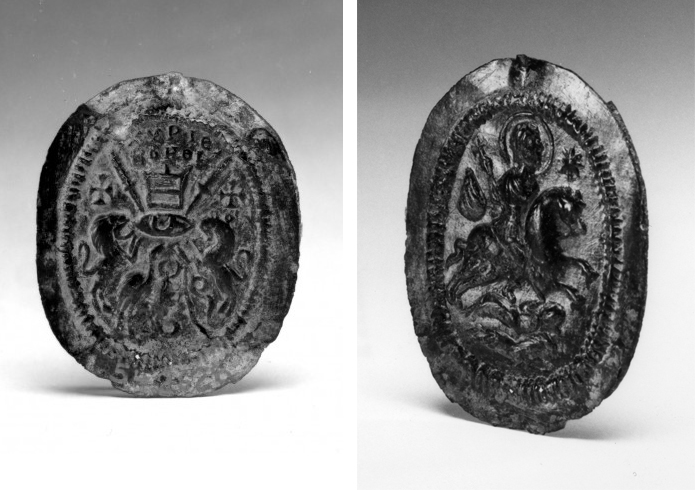
Amulet with the Evil Eye (attacked by weapons and animals) and the Holy Rider (who spears the female person demon Gyllou), early Byzantine, 5th–6th century, statuary, ii 10 v cm (photograph: The Walters Art Museum, CC0)
Christian motifs also functioned as amuletic devices to protect or heal through their materials and iconography. An elaborately engraved early on Byzantine amulet depicting the Woman with the Effect of Blood is inscribed with an abbreviation of the relevant biblical passage (Mark 5:25-34). Information technology was intended to cure its owner, who presumably suffered from a similar ailment. The object'due south material—hematite—was believed to staunch the flow of blood, and the epitome would have operated sympathetically, healing the possessor of the amulet (who is possibly represented in the praying effigy on the opposite) just every bit Christ healed the woman who sought his assistance. [iii]
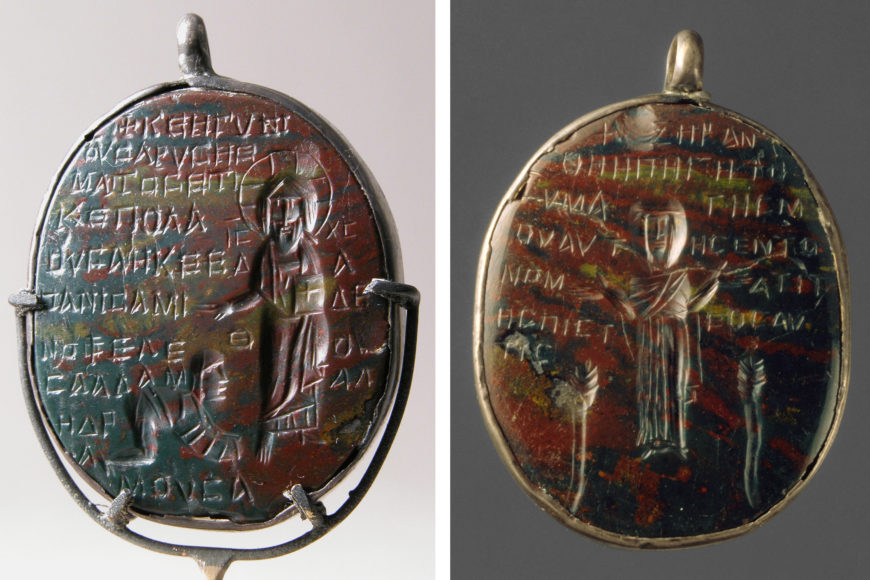
Amulet depicting the Woman with the Issue of Claret and Christ (obverse) and a praying figure (contrary), Early on Byzantine, Egypt, 6th–7th century, hematite and silverish (mount), c. five ten iv ten 1 cm (The Metropolitan Museum of Art)
In the heart Byzantine era, a common detail of wearable art was the pectoral cross. Statuary examples are attested in large numbers. They are decorated with inscriptions and images, often crudely executed. [4] Constructed from two parts held together by a swivel and pin, the crosses could exist opened and filled with holy substances, including relics and contact relics.
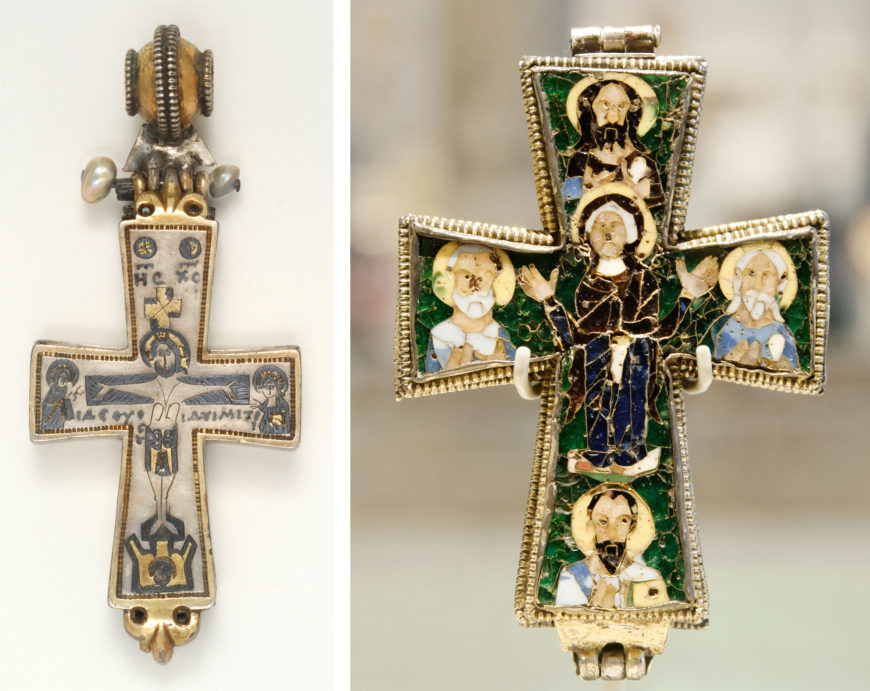
Left: Enkolpion Reliquary Cross with Crucifixion and the Virgin, 10th–11th century, silver, gilding and niello, 9.iii x 4 x 0.8 cm (photo: © Dumbarton Oaks); right: Beresford Hope Cantankerous, 9th century, gold, silver, cloisonné enamel, 8.7 x five.8 x one.8 cm (photograph: Marie-Lan Nguyen, CC Past 2.v)
More luxurious pectoral crosses might be made from precious metals or enamel. Over the class of the center Byzantine era, enkolpia became an integral function of personal devotion and were closely aligned with an private'south identity. Some examples were made from luxurious materials—including gold, enamel, pearls, and precious stones—and they were inscribed with prayers for the salvation and defence of the owner. An especially elaborate enkolpion depicts Saint Demetrios (obverse) and the soldier martyrs, Saints Sergios and Bacchos (reverse). A pin at the top can be unscrewed, allowing the container to open. Within two doors are revealed behind which reclines a miniature figure of the saint that probable references his pilgrimage shrine, which was thought to be a site for miracles. An inscription on the border of this object indicates that information technology once held a blood relic of Saint Demetrios along with the contact relic of the miraculous balm (oil) excreted at his tomb: "The organized religion of Sergios [the owner] carries the venerable receptacle of Demetrios' claret together with the balm. He asks to have you lot every bit protector, while he is living, and when he is expressionless, forth with the two martyrs who accept won the prize."
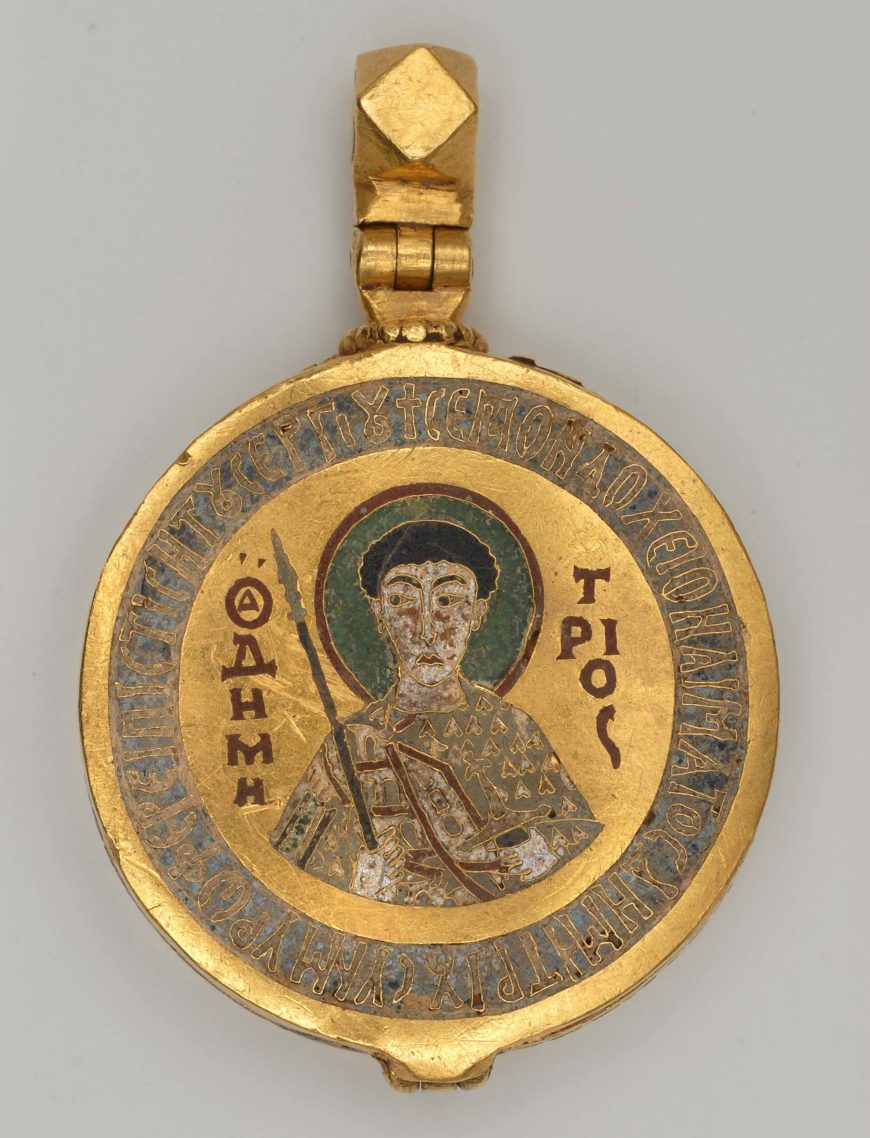
Reliquary of St. Demetrios, Heart Byzantine, early 13th century, enamel on golden, c. iv cm x 3 cm 10 1 cm (Dumbarton Oaks)
Throughout Byzantine history, personal beautification was often contested by Christian commentators, who associated elaborate jewelry and wearable with vanity and fornication. While some ecclesiastical regime brash that the devout should adorn their bodies with just religious imagery, others criticized such practices as a form of false devotion, arguing that proper Christian behavior required the hard piece of work of adorning the soul through adept deeds rather than the quick gear up of merely wearing Christian identity on one's sleeve. Throughout these discussions it is clear that the Byzantines attended carefully to personal appearances, and the materials, motifs, and designs worn on the torso were judged as a reflection of an private'southward social and spiritual grapheme.
Notes:
[ane] Myrto Hatzaki, "The Byzantine Ideal of Beauty: Definitions and Perceptions," Beauty and the male body in Byzantium: perceptions and representations in fine art and text (New York: Palgrave Macmillan, 2009), esp. 26.
[two] H. B. Dewing, trans., Procopius: The Anecdota or Hole-and-corner History, Loeb Classical Library 290 (Cambridge, MA: Harvard University Printing, 1935), 78-81.
[three] Jacquelyn Tuerk Stonberg, "An Early Byzantine Inscribed Amulet and Its Narratives," Byzantine and Modern Greek Studies (1999): 25-42.
[4] Brigitte Pitarakis, Les croix-reliquaires pectorales byzantines en bronze (Paris: Picard, 2006).
Boosted resources
Smarthistory's free Guide to Byzantine Art e-book
Christopher Entwistle and Noël Adams, Intelligible Beauty: Recent Research on Byzantine Jewellery (London: British Museum, 2009)
"Gold Jewelry Technique: Wire," The Metropolitan Museum of Art
"Gold Jewelry Technique: Granulation," The Metropolitan Museum of Art
Quinn Hargitai, "The foreign ability of the 'evil eye,'" BBC, Feb 19, 2018
Brigitte Pitarakis, "Objects of Devotion and Protection," in Byzantine Christianity, edited by Derek Krueger and Denis R. Janz, A People's History of Christianity 3, 164-81 (Minneapolis: Fortress Printing, 2010).
Edmund C.Ryder, "Popular Religion: Magical Uses of Imagery in Byzantine Art," In Heilbrunn Timeline of Art History (New York: The Metropolitan Museum of Art, September 2008)
Thelma K. Thomas, ed. Designing Identity: The Power of Textiles in Late Artifact (Princeton: Princeton Academy Press, 2016)
Alicia Walker, "Bodily Beautification in Byzantium: Objects and Images," inThe Oxford Handbook of Byzantine Art, ed. Ellen Schwartz (Oxford: Oxford University Press, 2021)
Warren T. Woodfin,The Embodied Icon: Liturgical Vestments and Sacramental Power in Byzantium (Oxford: Oxford University Press, 2011)
robertsagetwoubding.blogspot.com
Source: https://smarthistory.org/wearable-art-byzantium/
0 Response to "Created Art of the Byzantine Byzantine Art Is Usually"
Postar um comentário