How to Read Kurtosis From Box Plot
What does a box plot tell you?
Past Saul McLeod, published 2019
What is a box plot?
In descriptive statistics, a box plot or boxplot (too known every bit box and whisker plot) is a type of chart oft used in explanatory data analysis. Box plots visually testify the distribution of numerical information and skewness through displaying the data quartiles (or percentiles) and averages.
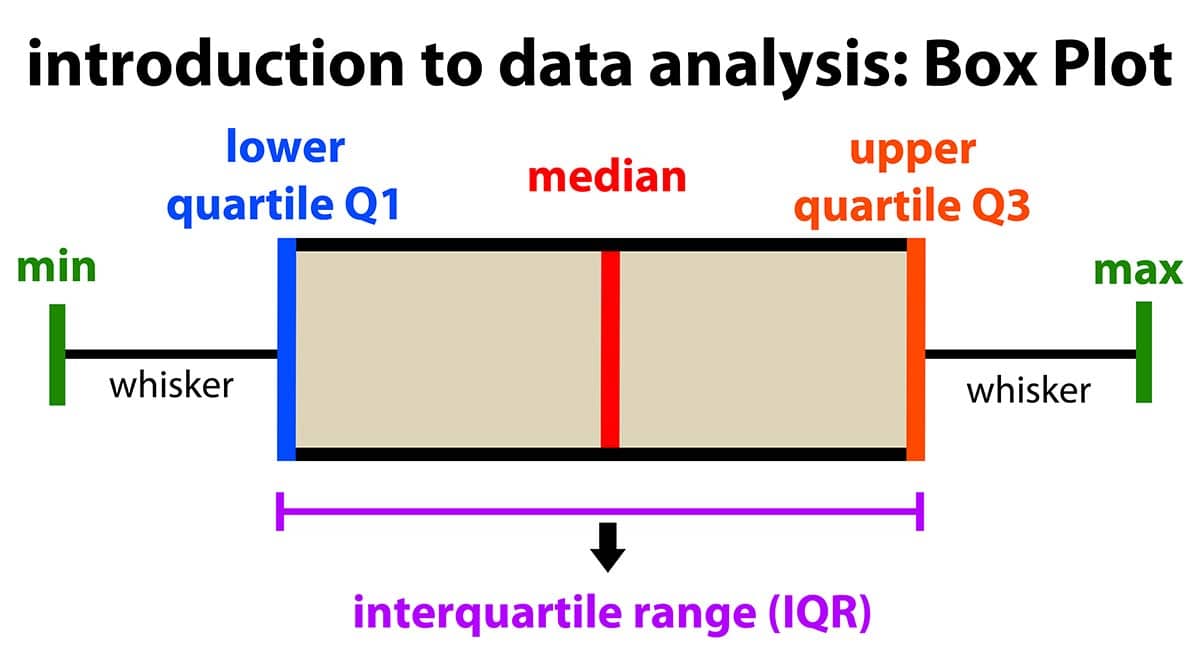
Box plots show the five-number summary of a set of information: including the minimum score, first (lower) quartile, median, third (upper) quartile, and maximum score.
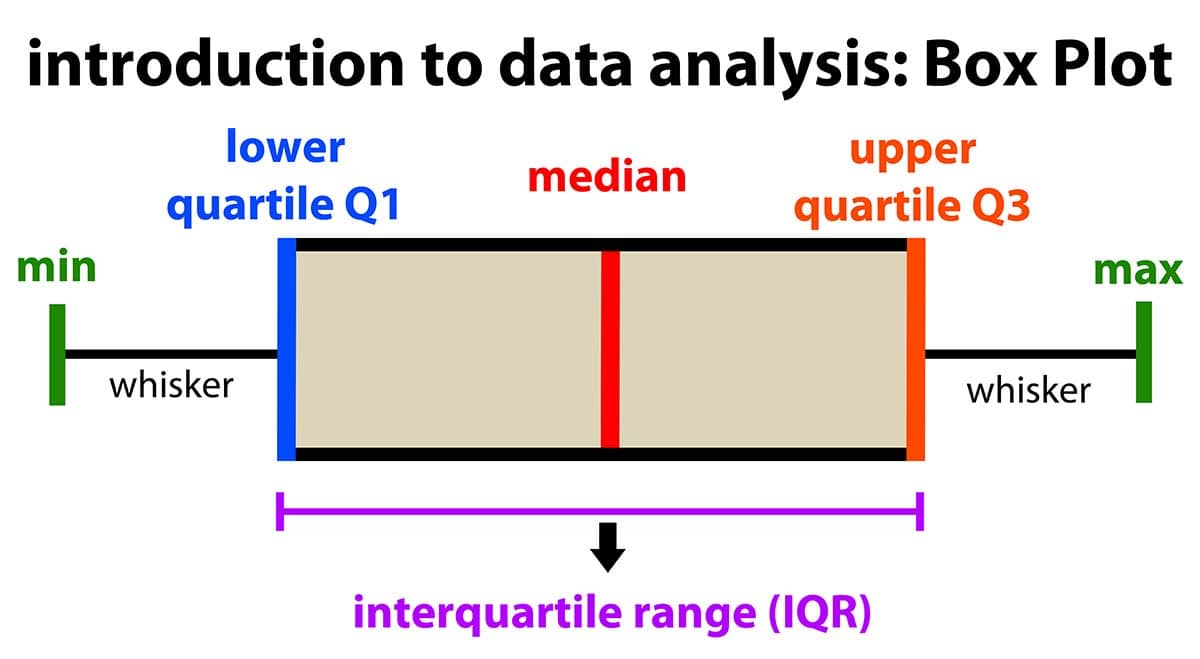
Definitions
Minimum Score
The everyman score, excluding outliers (shown at the finish of the left whisker).
Lower Quartile
Xx-five percent of scores fall below the lower quartile value (also known equally the first quartile).
Median
The median marks the mid-betoken of the data and is shown past the line that divides the box into ii parts (sometimes known as the second quartile). Half the scores are greater than or equal to this value and one-half are less.
Upper Quartile
Seventy-five percent of the scores fall below the upper quartile value (also known as the tertiary quartile). Thus, 25% of information are above this value.
Maximum Score
The highest score, excluding outliers (shown at the end of the right whisker).
Whiskers
The upper and lower whiskers represent scores outside the centre 50% (i.e. the lower 25% of scores and the upper 25% of scores).
The Interquartile Range (or IQR)
This is the box plot showing the middle fifty% of scores (i.e., the range between the 25th and 75th percentile).
Why are box plots useful?
Box plots divide the data into sections that each contain approximately 25% of the data in that gear up.

Box plots are useful as they provide a visual summary of the information enabling researchers to quickly identify mean values, the dispersion of the data fix, and signs of skewness.
Note the image above represents information which is a perfect normal distribution and most box plots will not adjust to this symmetry (where each quartile is the same length).
Box plots are useful as they testify the average score of a information set.
The median is the average value from a set of data and is shown by the line that divides the box into two parts. One-half the scores are greater than or equal to this value and half are less.
Box plots are useful every bit they show the skewness of a information set
The box plot shape volition show if a statistical data gear up is normally distributed or skewed.

When the median is in the heart of the box, and the whiskers are about the same on both sides of the box, then the distribution is symmetric.
When the median is closer to the bottom of the box, and if the whisker is shorter on the lower terminate of the box, then the distribution is positively skewed (skewed right).
When the median is closer to the superlative of the box, and if the whisker is shorter on the upper stop of the box, and so the distribution is negatively skewed (skewed left).
Box plots are useful equally they evidence the dispersion of a data set.
In statistics, dispersion (also called variability, scatter, or spread) is the extent to which a distribution is stretched or squeezed.
The smallest value and largest value are found at the end of the 'whiskers' and are useful for providing a visual indicator regarding the spread of scores (e.g. the range).

The interquartile range (IQR) is the box plot showing the middle 50% of scores and tin be calculated past subtracting the lower quartile from the upper quartile (e.one thousand. Q3−Q1).
Box plots are useful as they testify outliers within a information set.
An outlier is an ascertainment that is numerically distant from the residue of the data.
When reviewing a box plot, an outlier is divers as a data bespeak that is located exterior the whiskers of the box plot.

Source: https://towardsdatascience.com/understanding-boxplots-5e2df7bcbd51
For example, outside i.5 times the interquartile range above the upper quartile and beneath the lower quartile (Q1 - 1.5 * IQR or Q3 + i.5 * IQR).
How to compare box plots
Box plots are a useful mode to visualize differences amidst different samples or groups. They manage to provide a lot of statistical data, including — medians, ranges, and outliers.
Note, although box plots take been presented horizontally in this article, information technology is more mutual to view them vertically in research papers
Step one: Compare the medians of box plots
Compare the corresponding medians of each box plot. If the median line of a box plot lies outside of the box of a comparison box plot, and then in that location is likely to be a deviation between the ii groups.

Source: https://blog.bioturing.com/2018/05/22/how-to-compare-box-plots/
Step ii: Compare the interquartile ranges and whiskers of box plots
Compare the interquartile ranges (that is, the box lengths), to examine how the data is dispersed between each sample. The longer the box the more than dispersed the data. The smaller the less dispersed the data.

Next, look at the overall spread equally shown by the extreme values at the stop of ii whiskers. This shows the range of scores (some other type of dispersion). Larger ranges indicate wider distribution, that is, more scattered data.
Stride 3: Wait for potential outliers (see above image)
When reviewing a box plot, an outlier is defined every bit a information betoken that is located outside the whiskers of the box plot.
Step 4: Await for signs of skewness
If the data do not appear to be symmetric, does each sample show the same kind of asymmetry?

How to reference this article:
How to reference this commodity:
McLeod, S. A. (2019, July 19). What does a box plot tell you? Merely psychology: https://world wide web.simplypsychology.org/boxplots.html
Home | Nearly Us | Privacy Policy | Advertise | Contact Us
Merely Psychology'south content is for advisory and educational purposes only. Our website is not intended to be a substitute for professional medical advice, diagnosis, or treatment.
© Simply Scholar Ltd - All rights reserved

robertsagetwoubding.blogspot.com
Source: https://www.simplypsychology.org/boxplots.html
0 Response to "How to Read Kurtosis From Box Plot"
Postar um comentário